
Portable Storage Containers vs. Full-Service Movers: Which Is Better for Your Move?
With portable storage, a container is delivered to your property, you generally pack and load it on your own schedule, and the provider transports it when you are ready. Full-service movers take on more of the physical work, typically handling loading, transportation, and unloading, with packing or unpacking available depending on the service.
There is also a middle ground: you can use a portable storage container while hiring moving labor to help with loading or unloading. The right option comes down to cost, convenience, flexibility, storage needs, access, and how hands-on you want to be.

Portable Storage vs. Traditional Movers at a Glance
| Factor | Portable Storage | Full-Service Movers |
|---|---|---|
| Physical work | You typically handle packing and loading unless you hire help. | The moving crew typically handles loading and unloading. |
| Timeline control | Load and unload over a longer window based on your schedule. | Work is generally completed within scheduled moving appointments. |
| Temporary storage | Transportation and temporary storage can be combined using the same container. | Storage may be available separately or as storage-in-transit, depending on the mover. |
| Property access | Requires suitable space and access for container delivery and pickup. | Requires safe access for the moving truck and crew. |
| Convenience | More hands-on, but offers greater control over the moving process. | Less physical work for the homeowner and more crew involvement. |
| Cost structure | Depends on container use, transportation, storage time, and added labor. | Depends on labor, distance, move size, services, and other move-specific factors. |
How Portable Storage Containers and Full-Service Movers Work
Before comparing cost, convenience, and flexibility, it helps to understand how each moving model typically works.How a Portable Storage Container Move Works
With a portable storage move, the provider delivers a container to the customer’s property. The customer generally packs belongings, loads the container, and secures everything inside on their own schedule. If they do not want to handle the lifting themselves, they can hire moving labor to help with loading or unloading.Once the container is ready, the provider transports it to the new home or, when available, holds it in storage during the transition. That means the same container can support both the move and temporary storage without requiring the belongings to be transferred into a separate storage unit.
At the destination, the customer typically unloads the container before the provider picks it up. This model gives the homeowner more control over timing, but it also generally requires more hands-on involvement.
How a Full-Service Move Works
With a full-service move, the moving company provides a professional crew that typically handles loading, transportation, and unloading. This reduces the amount of physical work the homeowner needs to take on and shifts more of the moving logistics to the crew.The exact level of service varies by company and package. Some movers also offer packing, unpacking, specialty-item handling, or other add-on services.
If temporary storage is needed, some moving companies can arrange warehouse storage or storage-in-transit as part of the move or as a separate service. Unlike the portable storage model, however, the belongings may not necessarily remain in the same container or storage space throughout the transition.

Key Differences Between Portable Storage and Full-Service Movers
The biggest differences become clearer once you think about what you actually want help with. Are you trying to avoid the heavy lifting? Do you need extra time between homes? Would temporary storage solve a timing problem? Cost matters, of course, but so do access to the property, the amount of work involved, and how much control you want over the schedule.
Those are the factors that usually determine whether portable storage or full-service movers make more sense for a particular move.Cost
When comparing portable storage vs. movers cost, the lowest initial quote does not always represent the total cost of the move. What matters is which services are included and which ones you will need to add.Portable storage may cost less when you are comfortable packing and loading yourself, do not need extensive professional labor, and already need temporary storage as part of the move. It may also make sense when one container can handle the move without extra trips, additional containers, or significant add-on services.
Full-service movers may provide better value when professional labor is a priority. If you have a large amount of furniture, heavy items, stairs, elevators, difficult access, or belongings that require more complicated handling, paying for a crew can reduce both the workload and the logistical burden on you.
For either option, the final price can change based on factors such as distance, labor, storage duration, the number of containers needed, packing services, stairs or elevators, specialty items, access conditions, and additional trips or services.
For a closer look at how container pricing is calculated, see our guide to moving container cost.
Labor and Physical Effort
One of the biggest differences between a moving container and full-service movers is simply how much work you want to do yourself.With portable storage, you generally pack your belongings, carry them to the container, arrange and secure them inside, and unload them after delivery. That gives you more control over the process, but it also means taking on more of the physical work.
That does not mean you have to handle everything alone. Moving labor can often be hired separately to help with loading, unloading, or both, creating a middle ground between a completely do-it-yourself move and a traditional full-service move.
With full-service movers, the crew typically handles the major lifting, loading, transportation, and unloading. Packing and unpacking may also be available depending on the moving company and service package.
So the decision is not simply about which option costs less. An equally important question is: How much physical work do you want to do yourself?
Flexibility, Scheduling, and Control
Convenience means different things depending on what part of the move you want to make easier. If your biggest concern is avoiding the lifting and loading, full-service movers have a clear advantage: once the crew arrives, much of the physical work is handled for you.
Portable storage solves a different problem. Instead of concentrating the move into one scheduled loading window, you can often spread the work out over more time. That can make it easier to pack gradually, decide how the container is organized, or work around a gap between move-out and move-in dates. Temporary storage can also become part of the same process when needed.That is the key distinction: full-service movers generally provide more physical convenience, while portable storage can provide more scheduling and logistical flexibility. Exact timing and availability still depend on the provider.
Temporary Storage and Moving Logistics
Temporary storage can significantly change the comparison, especially when a move does not happen in one continuous step.Portable storage naturally supports a process such as:
Home A → Container → Temporary Storage → Home B
Your belongings can be loaded once, transported, held in storage when that service is available, and then delivered when the destination is ready. This can simplify the logistics when closing dates do not align, a renovation delays move-in, or you need belongings out of the home temporarily.
In other words, a moving container with storage can allow transportation and temporary storage during a move to function as parts of the same process.
Traditional moving companies may also offer storage. Depending on the company, this could include warehouse storage, storage-in-transit, or another storage arrangement. In some cases, belongings may need to be moved into and later out of that storage space, creating an additional handling step.
Portable storage is therefore not the only way to store belongings during a move. The distinction is that storage is built naturally into the portable-container model, while with full-service movers it may be an additional service or logistical step.

Convenience, Handling, and Protection
The better option can also depend on what you are moving and how much control you want over handling it.Full-service movers may be a better fit when the home contains many heavy items, large furniture, stairs, or difficult access. Professional crews can also be useful when furniture needs to be disassembled and reassembled or when specialty belongings require experienced handling. For homeowners who want minimal physical involvement, this can be a major advantage.
Portable storage may appeal more to people who want direct control over how their belongings are packed and loaded. You can decide which items go in first, how boxes are arranged, and how much time to spend organizing the load.
Neither approach automatically provides better protection. The outcome depends on factors such as packing quality, loading technique, the types of items being moved, how well belongings are secured, provider policies, and any available protection or valuation options. For interstate moves, the Federal Motor Carrier Safety Administration explains the liability and valuation options that moving companies are required to offer.
The main difference is therefore less about declaring one method safer and more about who takes responsibility for handling the belongings and how much control you want over that process.
Does the Better Option Change for Local vs. Long-Distance Moves?
Distance does not automatically determine whether portable storage or full-service movers are the better choice, but it can change which factors matter most.Local Moves
For a local move, the shorter transportation distance may make it easier to complete the move within a tighter timeline, sometimes even in a single day. Local moving labor may also be readily available if you want help with the heavy lifting.The main questions are often whether temporary storage is needed and how much physical work you want to handle yourself. If the move is straightforward and the new home is ready immediately, either option may work well. If you need extra time between homes, portable storage can become more useful even over a short distance.
Long-Distance Moves
With a long-distance move, transportation timing and coordination often become more important. Move-out and move-in dates may be farther apart, temporary storage may be necessary, and delivery schedules or route availability can affect the plan.A portable container can be useful for homeowners who want to pack on their own schedule without driving the loaded container themselves. Full-service movers may be preferable when minimizing physical work and coordinating professional handling across a longer distance are bigger priorities.
For more detail on planning a move across a greater distance, see our guide to long-distance moving.
Portable Storage vs. Movers: Which One Fits Your Move?
The better choice depends on which parts of the moving process you want more control over and which responsibilities you would rather hand off.Choose a Portable Storage Container If…
Portable storage is worth considering when control over the timeline matters more than having someone else manage every part of the move. Maybe you want to pack gradually instead of having everything ready for one moving day, or perhaps your new home will not be available as soon as you leave the old one. In those situations, being able to combine transportation with temporary storage can simplify the transition.
It can also work well if you prefer deciding how your belongings are packed and arranged. You will generally take on more of the loading and unloading yourself, but moving labor can be hired if you want help with the heavier work. The property also needs enough practical access and space for container placement.Choose Full-Service Movers If…
Full-service movers make more sense when reducing the physical workload is one of your highest priorities. A professional crew can handle the major lifting, loading, transportation, and unloading, which becomes especially valuable when a move involves large furniture, heavy belongings, stairs, elevators, or other difficult access conditions.
This option may also fit better if you want packing or unpacking services or simply prefer to hand off more of the moving-day logistics. And if there is no practical place for a portable container at your home, a traditional moving service may be the more workable choice.Consider a Portable Container Plus Moving Labor If…
You do not necessarily have to choose between a self-managed container move and a fully staffed moving service.
Hiring moving labor to load or unload a portable container can give you the scheduling flexibility and temporary storage advantages of the container model without requiring you to handle all of the heavy lifting yourself. You can still pack gradually, control the moving timeline, and keep transportation and storage connected while bringing in professional help for the most physically demanding parts.This middle-ground approach can be especially useful when you like the logistical flexibility of portable storage but do not want the physical workload of loading and unloading everything on your own.
Think portable storage might fit the way you want to move?
Explore how portable containers can work for moving, temporary storage, or a combination of both before deciding which setup makes sense for you.
Explore Portable Storage Options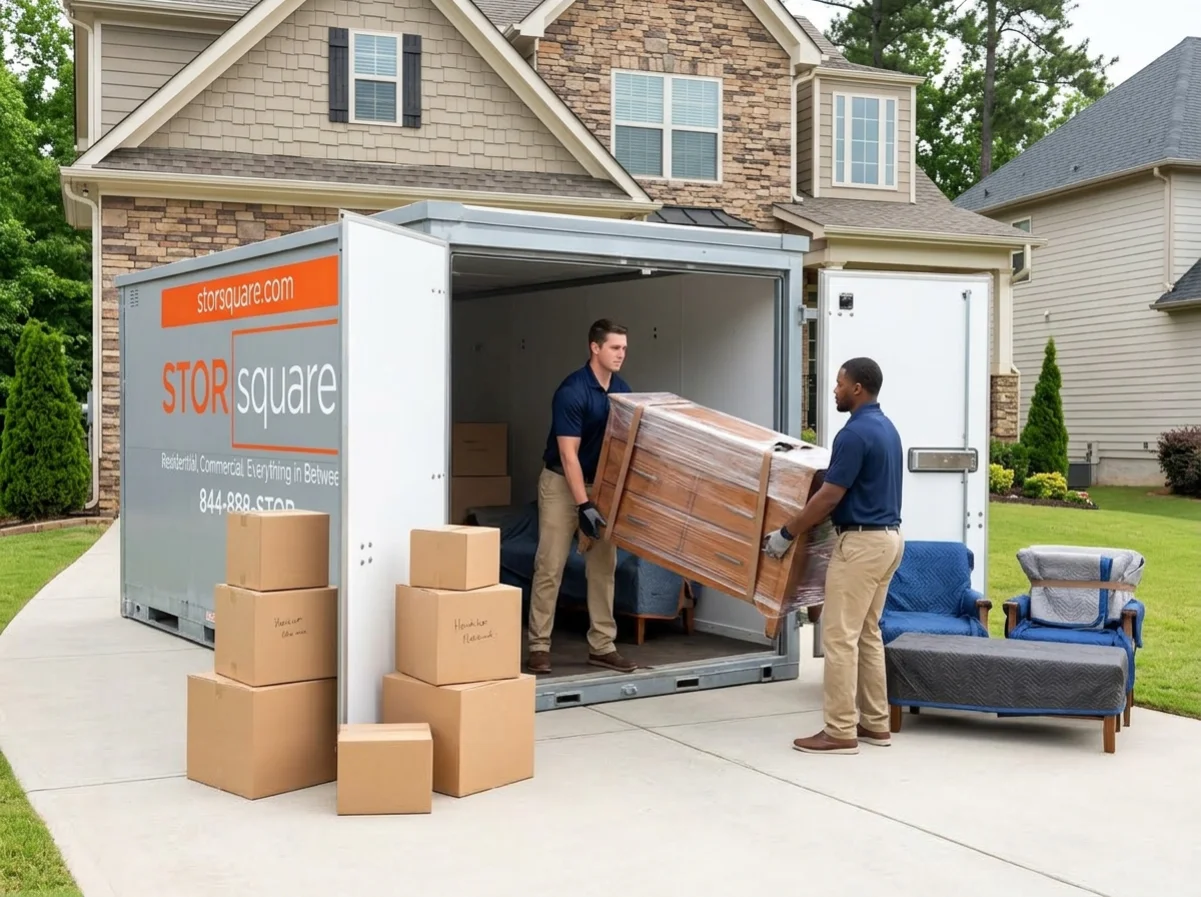
How to Compare Portable Storage and Moving Company Quotes Fairly
A portable storage quote and a full-service moving quote may look far apart at first because they often include different services. To compare them fairly, look beyond the headline price and make sure you are comparing equivalent levels of help.Check whether each quote includes:
- Transportation, including container delivery and pickup where applicable.
- Packing, packing materials, loading, and unloading.
- Labor at the origin and destination.
- Storage duration, additional containers, or extra trips.
- Mileage, stairs, elevators, parking, or other access-related charges.
- Specialty-item handling and any additional services the move requires.
- Protection or valuation options.
- Cancellation, rescheduling, and expected delivery terms.
The most useful comparison is not simply which quote is lower, but what you receive for that price and which additional services you would still need to arrange.
Portable Storage vs. Movers: A Simple Decision Framework
If you are still weighing the options, start with the part of the move that matters most to you.| If your priority is… | Start by considering… |
|---|---|
| Minimizing physical work | Full-service movers |
| Packing gradually | Portable storage |
| Temporary storage between homes | Portable storage |
| Difficult access or many heavy/specialty items | Full-service movers |
| Scheduling flexibility without doing all the heavy lifting | Portable storage + hired labor |
| No suitable place for a container | Full-service movers |
No single factor has to decide the move on its own. A homeowner who needs temporary storage might still choose full-service movers because the physical work matters more, while someone who dislikes heavy lifting might still prefer a container and hire a crew just for loading. Use the priorities above as a starting point, then compare the complete service and cost of the options available for your move.
What Makes STORsquare Different If You Choose Portable Storage?
If portable storage fits the way you want to move, STORsquare offers a moving and storage solution built around that model. You can choose from multiple container sizes, load on your schedule, and use the same container for moving and temporary storage when needed.
STORsquare also adds support and predictability through features such as a Dedicated Rental Coordinator, Delivery Date Guarantee, Transparent Pricing Guarantee, and Container Placement Guarantee. Its no-tilt delivery system is designed to keep the container level during placement and pickup.
Does portable storage sound like the right fit for your move?
Tell us what you’re moving, where it needs to go, and whether you need storage along the way. We’ll help you start with the right container setup for your plans.
Request a Free Quote